Monday, April 25, 2016

Tater Boxes


Since we cut down Doug, the fir, we have a lot more sunny space to work with in the front yard, at least until the apple trees grow up a bit. I figured I'd try my hand at growing potatoes in pots. So, I bought eighteen industrial grade 5-gallon garden pots (they actually only hold 3.5 gallons, oddly). And, since this is a front-yard garden, aesthetics are important. I thought I could hide the black plastic with some nice cedar boxes, six to a box. The pots are just under 12 inches in diameter, and about 11 inches tall this giving me my rough dimensions. I would add a bit to the width to make room for soil to cover the drain holes as is done in this type of planting. My inside dimensions worked out to 16 inches wide, by 6 feet 2 inches long.

Pro Cal Pro-can #5s, made in the US of A of recycled materials.
The sides of the boxes are 5/4-inch cedar decking, which comes in 5-1/2 inch widths 8 feet in length. I was able to get one side and one end piece from each board. Since the boxes are two boards high, I would need a total of four boards for each box, or twelve boards for three boxes (ten bucks a pop). The corners would be made from 2" x 4"s and 2" x 2"s cut to 11 inches to match the height of the two 5-1.2 inch side boards, and a single 2" x 4" x 11" board in the middle of each box. Then, for a more finished look, I capped each box with a corner mitered 1" x 4" all the way around the top.

All of the pieces for all three boxes, sans 1" x 4" cedar finish top trim, cut to length.
Each end piece was predrilled and screwed with 3-1/8 inch all-weather screws.

The T-10 trim-head screws used in this project. Fantastic screws.
First box ready for corner pieces.

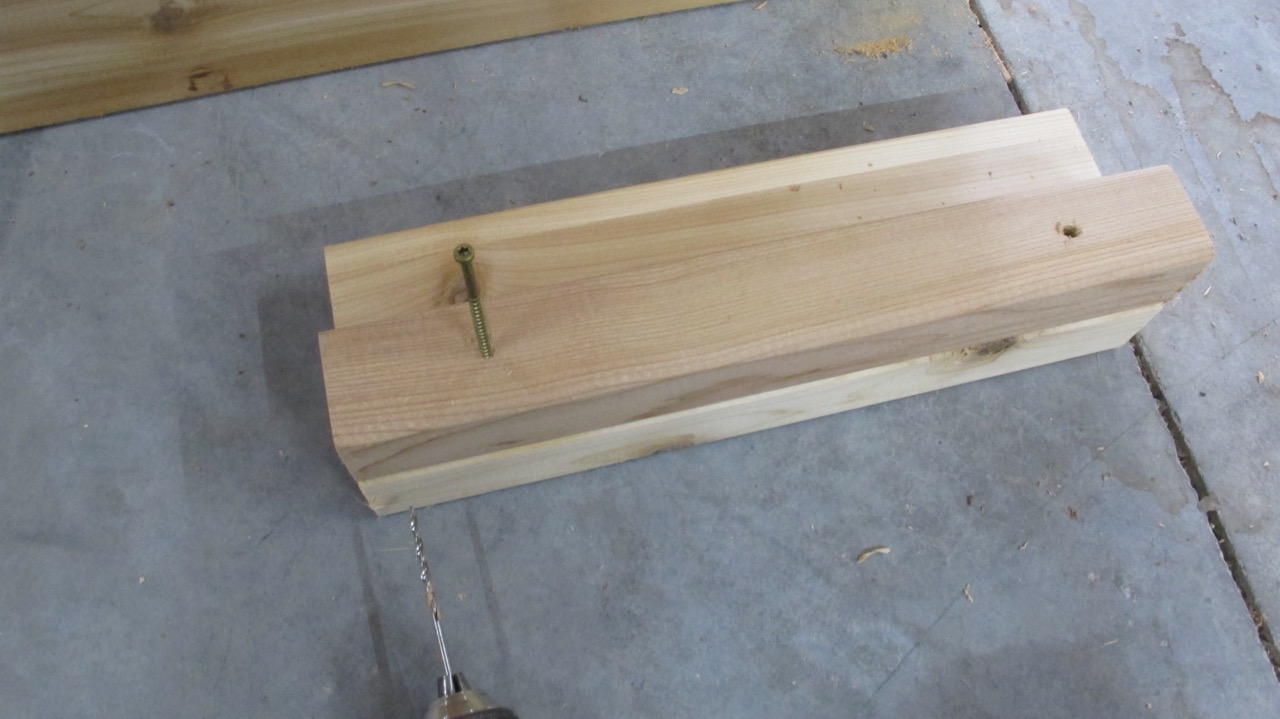
The corner pieces, pre-drilled and screwed together with 2-1/2" screws.

I attached the corner pieces two with 3-1/8 inch screws through the 2" x2"s top and bottom, into the side planking. Then, from the  inside using 2-1/2 inch screws at an angle through the side planking into the corner 2" x 4"s. This ensures a clean from on each box.

The center 2" x 4" is screw from the back (inside the box) using two 2-inch screws.

The finish top plate of 1" x 4" cedar required six pieces for the sides, and two for the six end pieces., mitered to fit nicely.
I first pre-drilled and screwed each corner using a 3-1/8 inch screw.
Finally, I pre-drilled and screwed each board around the perimeter approximately every ten inches.
The finished boxes waiting to be terraced into the front lawn. Check back soon for that post.

Thursday, April 21, 2016

The Sight of Music

The Music garlic I planted last November has come up nicely. It was all we could do to hold back a few cloves of this delicious garlic to plant. We'll face the same dilemma this year.

The Story of Music (from the Seed Saver Catalog)

This Italian garlic variety was brought to Canada by Al Music in the 1980s from his homeland of Italy.

This sweet and pungent garlic consistently produces great crops.

  • Organic
  • Hardneck
  • 4-7 cloves per head
  • Very tight, durable heads
Garlic has a history of over 7,000 years of use in human culture and is native to central Asia. As well as being used for food, it has also been useful as a medicine, even as recently as World War I and World War II. 
Some European cultures have been known to associate garlic with "white magic" or spiritual protection, giving rise to the belief that it will ward off vampires.


Friday, April 8, 2016

Out With the Old, In With the New

I just received three of the five heirloom apple trees I ordered from Seed Savers in December of 2014. Two of the trees (Blacktwig and Knobbed Russet) had unsuccessful grafts and I'll have to wait until next year for those. The other three (Monarch, Sweet Brown, and Woodard) arrived safe and sound. These I planted yesterday, just in time for the torrential rains.

What is left of Doug, my Douglas fir, now reduced to firewood and waiting to dry out a bit then split.
This is the Monarch, and it will have a special place near the front door.
Had to dodge a few small roots left over from Doug. Not bad, though.  

Combined the rich loam with a little compost for aeration. Now I have only to wait five years for pie.

Monday, March 21, 2016

From Eyesore to Firewood: Chop, Chop.

I've been wanting to cut this 65-year-old Douglas fir (Doug, I like to call him) down for some time now. While it was healthy enough, it took a big hit during the ice storm of 1990, instantly becoming something of an eyesore. But now I have five semi-dwarf heirloom apple trees on the way from Seedsavers and I need a sunny place to plant them.
I hired Precision Tree Care because they were by far the cheapest. They also had the equipment to go over our porch roof and the beautiful bur oak in front.

I could have left it at Dr. Seuss, but it wasn't to be.

Almost there. Been nice knowing you, Doug.

Much better. Now but to move these last few logs to the back yard, split them, and let them cure for a couple of years before blowing them up the chimney in my Lopi fireplace insert

Friday, June 19, 2015

Sky High by the 4th of July

The tomatoes have been enjoying the warm weather. They're now about my height, on their way to Yao Ming's and beyond.

Friday, June 5, 2015

My Front Chard


The giant leaf chard is taking over this box. I'll have to eat it before it crowds out the beets, beans, peas, and cukes.
Time to replant the salad box, which has been growing since last November.
So far, everything has been exceeding expectations. The consistent rain has helped.


Thursday, May 14, 2015

Season Two

The boxes are all planted this year: broccoli, cabbage, cauliflower, brussels sprouts, kale, collards, 10 varieties of lettuce, arugula, dandelion greens, chard, 10 kinds of heirloom tomatoes, herbs, eggplant, peppers, carrots, beets, radishes, peas, beans, cucumbers, winter squash, melons.

The tomatoes, cabbages (kale, collards, etc.), peppers, and herbs were all started indoors in March. Everything else was directly planted.
I replaced one set of tomato cages (far right), with a bean, pea, and cucumber trellis.


The bean trellis was constructed with 3/4-inch conduit, cut to two 6'5" pieces and a 3'9" cross piece, and connected using conduit elbows.
Then trellis netting was then tied to each part of the frame.
The nylon netting is incredibly durable and should last several seasons, even if left out in the elements.